

The Milwaukee Repertory Theatre PresentsThe Fisherman’s Daughters: How Sisterhood Strengthens The Beauty of Home & Self-Discovery
/
PHOTO ACCREDITED TO MICHAEL BROSILOW
Home. For millions in mankind, it’s the physical four walls that contain all of the charming emotional, and familiar aspects of their childhood. Others dedicated to their emotional intelligence deem home as a feeling or sense of belonging. What warm memories and sultry smells immediately pop into your mind when you think of home? Whether it’s a set of overwhelming feelings or a memory of a physical house, the reminiscence of home always leads to one of two results: eagerness to leave home and create a new one for yourself, or the comfort and protection it brings for many to never want to leave.

PHOTO ACCREDITED TO MICHAEL BROSILOW
On Sunday, (January 11th,2026), Wisconsin playwright Katie Dahl’s words had life breathed into them as the lights went on during the opening night of The Fisherman’s Daughters at the legendary Milwaukee Repertory Theatre [located at 108 E Wells St, Milwaukee, WI, 53202]. Walking into the Stackner Cabaret, an intimate and cozy dinner-theatre, that will be home to The Fisherman’s Daughters until March 1st, it quickly became evident that the expectations and previous knowledge I had of the heartwarming play were going to be displayed more intricately and from a deeper perspective. It is more than a tale of two sisters who are like oil and water when it comes to analyzing their personalities and lifestyles. Director Molly Rhode created a musical testament whose purpose was intended for not only the characters but also the audience members to remember where we came from and what’s worth fighting for. As the curtains unrolled at the beginning of opening night, I was confident that the uncertainty of what I was about to witness would leave a lasting impact on my impression of a world full of sisterhood, home, and unknown challenges.
As the spotlight hits centerstage, the clock turns backwards and the year of 1908 rolls in. The quaint, wholesome, and modest town of Door County in Fish Creek, Wisconsin, takes on the role of home and the significant place of where the story begins to unfold. Older siter, Sarah Peteterson, demands the attention of the audience with her unknowing humor, unbothered attitude of what others think of her, and Peterson’s ability to remain herself around anyone and in any room. She’s the woman who walks 3.2 miles into town daily, wearing a long dark grey trench coat that belonged to her father, who went on to glory, who has never left Peterson Point and has taken on the responsibilities and legacy of the home her father created. It is displayed early on that Sarah is fascinated with the city of California, but struggles with exploration and intellectual activities such as reading. Although she leads a life full of simplicity and independence, that does not erase the fact that her father’s bloodline does not end with her.

PHOTO ACCREDITED TO MICHAEL BROSILOW
A calm and serene transition from greenery and woodlands to translucent pink and blue colors changes the atmosphere of the stage. Nora, the younger sister of Sarah Pete, is riding a ferry back to Door County after not being home for over 2 years since her father’s death. It was no solo trip, as she was sharing the ferry with a charismatic and joyful man named John. Her mind is scattered, with one part thinking of how her life drastically shifted while living in Chicago, and the other side full of doubt, fear, and uncertainty of how her sister will react once she returns home—unannounced. Nora and John emotionally connect through their love and intrigue of not only how Door County looks on the outside, but also how the small town makes them feel warm and cozy on the inside in times when they are longing for home. To be strangers and meeting for the first time, many intimate details of their childhood and current life struggles were discussed so freely.

PHOTO ACCREDITED TO MICHAEL BROSILOW
Nora’s return to Fish Creek was no scene in a family sitcom. Although everyone else in town, such as Charlie, the town’s energetic burst of energy, whose occupations were a handyman and delivery driver, was ecstatic about her returning home, Sarah Peterson’s reaction was just as her sister predicted it to be–as cold as a Wisconsin winter. You would think Nora was about to be put on trial the way she was bombarded with questions as Sarah began to interrogate her.
“Why did you leave right after dad’s funeral?”
“Why didn't you tell me you were coming?”
“How come you stopped sending me letters?”
“Why are you here?”
spewed out of the mouth of her hurt older sister, Sarah, and each question hit Nora like a ton of bricks she didn't see coming. The first few days after making an abrupt yet therapeutic entrance back into her hometown, the contrasting sisters clashed over values and how they both are coping with the loss of their parents and the strong foundation of what their sisterhood used to be. Nora quickly got accustomed to rural life after spending over two years in the big city of Chicago working as a schoolteacher. Assisting Nora in a smooth transition back home was the last priority of Sarah Peterson, but over time, the love and bond she once had with her sister were slowly being reignited, although she was battling it as if her life depended on winning that war. Little was she aware that a difficult decision was about to come their way head-on that would test not only what family meant to both sisters but also the significance of their home as well.

PHOTO ACCREDITED TO MICHAEL BROSILOW
After sharing a unique and overwhelming connection with Nora, John stepped off the ferry with a mission: fulfill the governor’s request for all Door County residents to sell their homes and move away so that the beautiful and glimmering Peninsula state park could be constructed on those acres. His charm, wit, and hundred-dollar smile swayed many residents to choose embarking on a new home over honoring the rich history of where they’d made a life for themselves in the small yet heartfelt city of Fish Creek. However, a few residents immediately declined and did not let John’s enchanting personality persuade them to build a new life elsewhere, specifically Nora. It was almost ironic to me as an audience member how Sarah Pete, who had lived in the family home from birth, was easily wanting to sell it, but Nora, who left home as soon as her father passed and became a city girl, didn’t hesitate to protect the significance and impact of her childhood home. This made her realize she was longing to stay there for good; this wasn’t a quick trip home for a few weeks, and then she’d resume life back in Chi-Town. Nora wanted to water her roots and stay in Door County for good. Not only was this a shocking revelation to herself but also to everyone else—-specifically her guarded and independent older sister, Sarah Pete.

PHOTO ACCREDITED TO MICHAEL BROSILOW
While Sarah had it made up in her mind that their family home would be preserved and still standing after selling the home to John and the governor of Door County, John’s honesty and Nora’s intelligence soon shared with her the harsh reality. After snapping back into reality, both sisters agreed not to sell the house they had grown up in and were currently shaping a new life inside, but John was determined for the women to sell it. The musical numbers added light-hearted fun and the spirit of joy throughout the play, but also emphasized the pain points of both sisters and why their childhood home meant so much to both of them. With the loss of her dear friend and feeling empty while living in the big city, Nora needed a reset, and Fish Creek was just that. The honoring and remembrance of the fisherman, also known as her dad, was Sarah’s reasoning; tearing down all their family history was not worth trading it in for the Peninsula State Park to be eye-candy to folks who would pass through the town on voyages. Throughout their entire lives, Nora was labeled as book-smart and Sarah Pete was labeled as handy, just like her father; she was the one who came up with how to save the house. A life-lease!
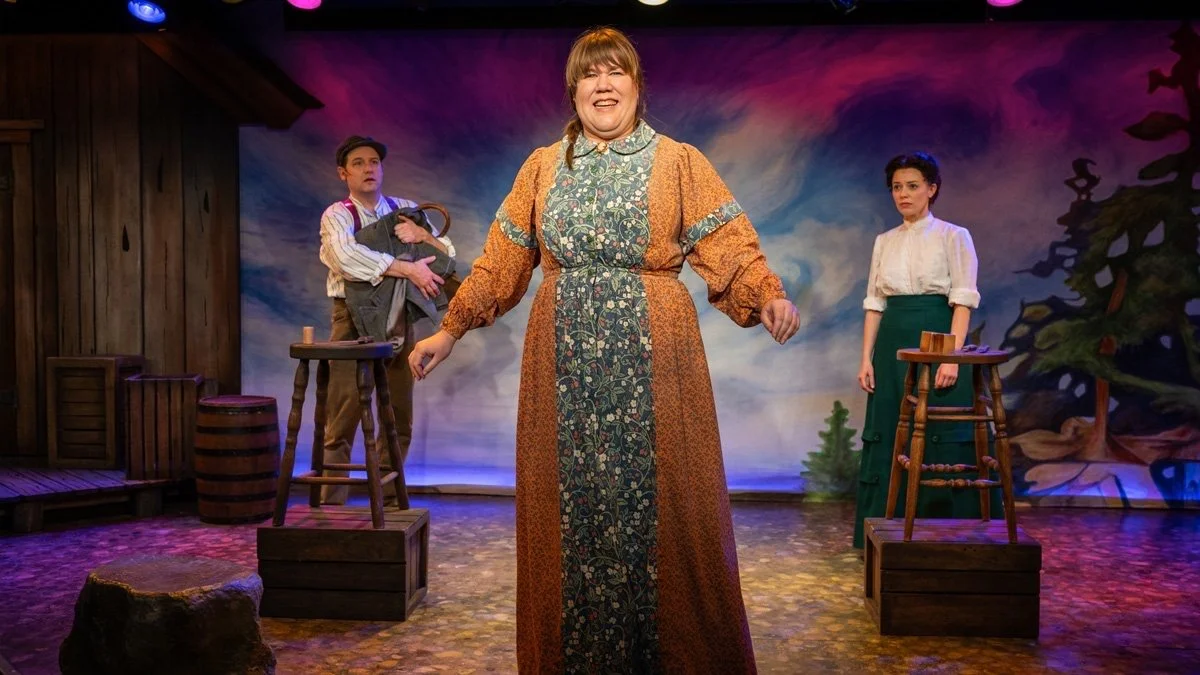
PHOTO ACCREDITED TO MICHAEL BROSILOW
Once John witnessed the toughing reconnection of sisterhood, family, and sense of belonging, he asked the governor if the two daughters of the fisherman could keep their home by having a life-lease: as long as they were alive, their home would not be demolished but protected during the construction of the Peninsula State Park. Due to the similarities of overcoming hardship and the origin story the governor shared with their father, the life lease was issued! [YES, THE LADIES SNATCHED THAT WIN UP DIDN’T THEY] With the certainty of Nora returning home, Sarah Pete went on an adventure herself to California–something she or anybody else thought she was ever capable of. She soon realized home was where she belonged, but that exploration is still rewarding even when you don’t stray from home long. Once transparency, unspoken expectations, hard conversations, and a threat of their childhood home being demolished came into play, sisterhood, community, and self-discovery became top priorities for the Peterson sisters, making their bond stronger than ever!
I walked away with a deeper appreciation and new perspective of what my home, Milwaukee, really means to me. So I ask again, what is home to you? Want to be reminded of the beauty of where you came from? Have you been feeling like home is where you need to be? Maybe we all get so caught up in the lives we’ve built for ourselves that we forget from time to time what truly matters. Sometimes it takes someone coming in from the outside who has no connection to what you’re used to, for you to realize just how special home can be. Grab your sister, brother, mother, or neighbor and experience a joyous, lighthearted, and innocent musical! Don’t wait until it’s too late for you to see the magic and specialty of The Fisherman’s Daughters. Buy your tickets now at https://www.milwaukeerep.com/shows/show/the-fishermans-daughters/. The show is running from January 1th-March 1st, 2026. Comment down below what is special about your home.
Desriana Gilbert | Entertainment & Social Journalist for /CW


